Buy or DIY with AI
Mar 6, 2026

A conversation with a business owner recently made something click.
They'd paid serious money for their digital presence. The experience hadn't been great. The service felt slow, changes always meant "dev time," and every request came with a price tag. They learned to live with what they had because touching it felt like it cost too much.
The thing is, it wouldn't cost much at all to move in a direction they actually wanted. Not anymore. The tools exist. The price has collapsed. But the bad experience and the price sensitivity just makes someone want to leave things how they are and move on.
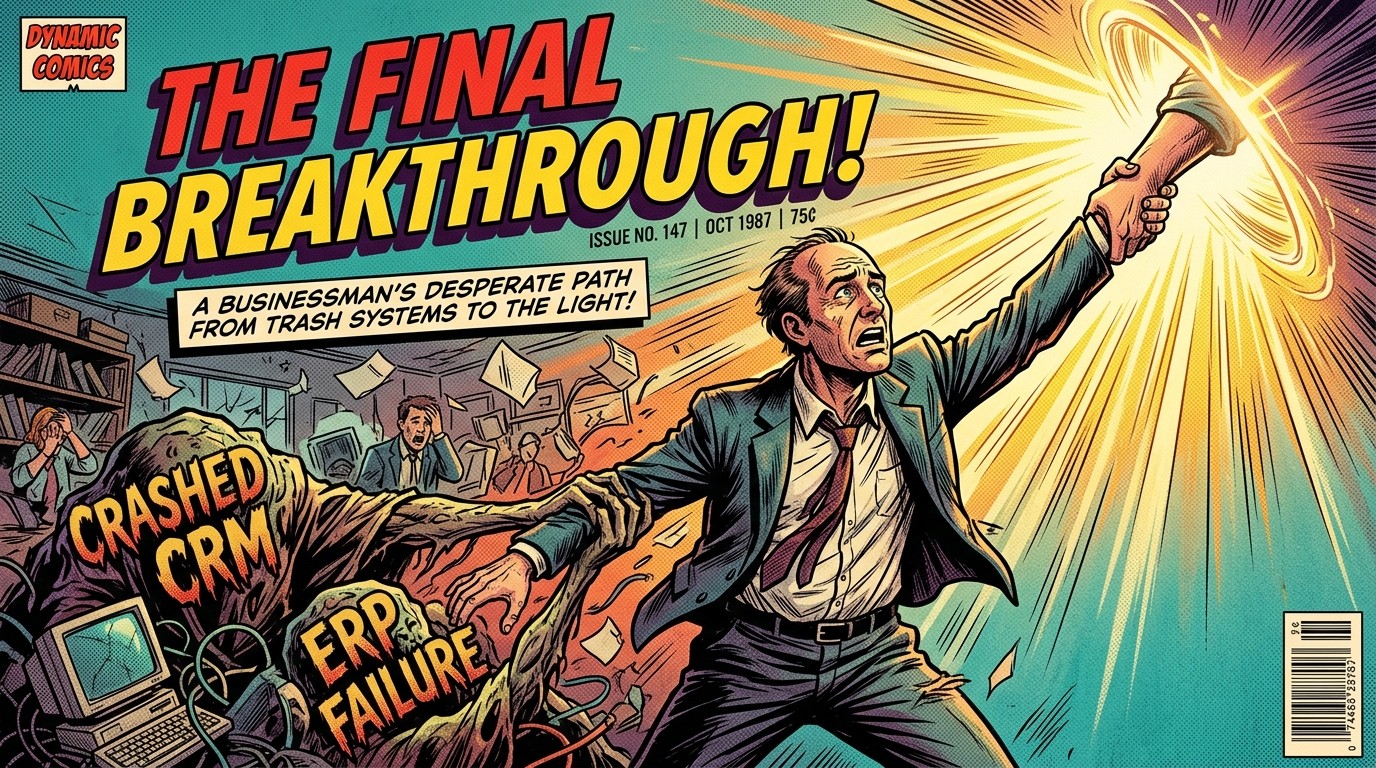
That's the trap a lot of business owners are in right now. They're making choices based on what burned them yesterday, and it sucks.
The Cost of Creating Has Collapsed
Let's put some ballpark numbers on this, because the gap is staggering.
A website or landing page. Two years ago, you were looking at $10-25k in agency fees. Today, with AI-assisted design and development tools, you can get comparable quality for under $1k. Not a toy. A real, functional, well-designed site.
Monthly content production. Used to be a $3-8k monthly retainer with an agency. Now it's a few hours of your time plus $50-100 in tooling. The output quality, when guided by someone who knows the subject, is genuinely competitive.
Internal automation. Custom development that would have cost $20-50k can now be built for $500-2k using no-code platforms and AI. Workflows that took weeks take days.
The barrier to entry has dropped through the floor.
Two Very Different Starting Positions
If you're starting a business today, you can build AI-native from day one. Lean infrastructure, modern tooling, no legacy drag. The advantage is significant.
If you're an existing business, you're facing a much harder problem. It's a triple lock, and all three parts compound to keep you stuck.
Sunk cost fallacy. "We already invested $X in this system." "We've been with this agency for three years." The money is spent. It shouldn't influence what you do next, but it almost always does.
Zero time to explore. This is the most common one. Business owners genuinely don't know what's possible now. They're comparing today's tools to what they tried eighteen months ago, and the landscape has changed completely since then.
The trust gap. They don't believe AI output can match what a "professional" agency delivers. In some cases they're right. In many cases, they're wrong and paying a premium for that assumption.
The Excel Problem
In Product Management, I'd always say: give an Excel user the option to design a new feature in your product, and it'll probably look like something they're already doing in a spreadsheet. The tool they know shapes how they think about the solution.
The same thing is happening with AI adoption. Existing businesses can't think AI-native because their mental models are pre-AI. They're trying to fit new capabilities into old frameworks.
Even I struggled with this at Fenrir Labs. Pricing, service delivery, how we think about the work..it was all initially based on pre-AI assumptions. It took deliberate effort to rethink from first principles rather than just bolting AI onto existing mental models.
Price sensitivity then creeps in. Incumbent business operators see the cost of AI tools and compare them to what they already know, not to what's actually possible. That comparison keeps them from experimenting, which keeps them from learning, which keeps them stuck.
The Pricing Revolution
The old model was simple. Your time is scarce, so you charge a premium. Agency rates reflected the cost of skilled people spending hours on your project. That made sense when the work genuinely took that long.
The new model is different. AI makes operators dramatically more efficient. I can work with more people, deliver faster, get things done in a fraction of the time. My time isn't as scarce anymore. The value equation has shifted from "How long does this take me?" to "How well can this operator leverage AI to deliver the right outcome?"
Here's the red flag you should be watching out for. Ff someone is charging you old-school agency rates in 2026, $15k+ for a website, $5k a month for content, that should be a problem. Either they're not using AI, which means they're inefficient, or they are using AI and keeping the margin, which means they're overcharging. Both should concern you.
This is also something I had to readjust myself. It's no longer a time scarcity equation. It's operator efficiency. And that's where the honest value proposition lives.
When You Should Still Buy
Before this sounds like "fire your agency and do everything yourself," there are real exceptions. And they matter.
Strategy and Taste
A person's subjective experience in a particular role gives them nuance that AI simply doesn't have. AI models are generalists. You want someone who can give the right context and nudge the model in a direction based on their undocumented, experiential knowledge. The kind of insight that hasn't been written down in any training dataset.
There may come a point where this nuance is embedded in models. But today, that unique perspective is the difference between competitive differentiation and being like everyone else who's using ChatGPT for their strategy.
If you're buying strategy, buy it from someone whose lived experience sharpens the AI output, not from someone who's just passing your brief to a chatbot.
Trust and Accountability
People with domain expertise can apply their knowledge with AI tooling. But you need someone evaluating the outcomes. It's a liability issue. You can't exactly say "well, AI told me this" when your product or service fails. You can't point at your AI system and shrug.
This is becoming a regulatory reality, not just a philosophical one. The EU AI Act hits a critical enforcement milestone in August 2026, with high-risk AI system requirements carrying penalties up to 35 million euros or 7% of global turnover. In the US, the December 2025 executive order on AI policy frameworks is creating a fragmented but increasingly demanding landscape. The UK is considering an AI Bill, having rebranded its AI Safety Institute to the AI Security Institute to signal a harder regulatory stance. And at the industry level, California's AB 489 and Texas healthcare AI laws both took effect in January 2026, with financial services facing growing explainability requirements.
The direction is clear: someone needs to be actively thinking about compliance alongside you. That's not a job for an AI tool. That's a job for a person who understands both the regulation and your business.
The Rethink
If you're an existing business owner and you haven't reassessed your spend in the last six months, you're missing out. The tools have changed. The costs have changed. The expectations should change too.
The tools are more accessible than they've ever been. The learning curve is flatter. The barrier between having an idea and bring it to live continues to collapse.
The first step is the hardest one. It's not technical. It's mental. Acknowledging that the old economics don't apply anymore. That what you paid last year for a website, a campaign, a workflow...that price is for a world that doesn't exist anymore.
So which is it going to be? Are you going to rethink how you build and buy, or keep paying yesterday's prices for yesterday's approach?